How Do Reverse Vending Machines Reduce the Waste Burden in Cities?
May 22, 2026
In today’s rapidly urbanizing world, waste management is no longer just an environmental concern—it has also become an operational and economic challenge. Packaging waste, in particular, constitutes a significant portion of urban waste streams, while existing collection methods are often insufficient to manage this volume effectively. In this context, reverse vending machines stand out as an important solution that brings greater control, measurability, and sustainability to urban waste management.
Source Separation of Waste
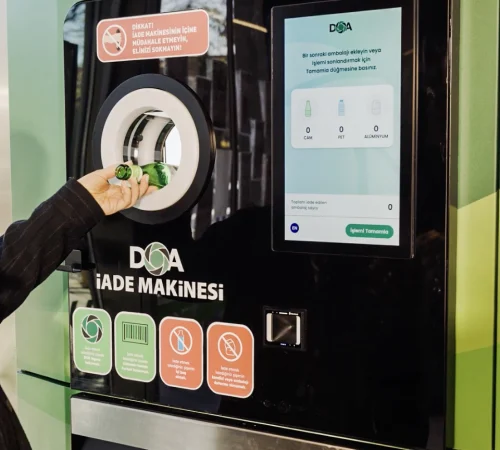
In traditional systems, waste is typically collected in mixed form, which lowers recycling quality and increases processing costs. Reverse vending machines, on the other hand, enable the separation of packaging waste at the source—directly at the point of consumption. Users return plastic, glass, or metal containers to the system, ensuring that collected materials remain clean and recyclable.
This approach reduces the overall waste volume in cities while supporting higher recovery rates.
From Uncontrolled Waste to Structured Collection
One of the main challenges in urban environments is the scattered and uncontrolled generation of waste. Due to the presence of street bins, recycling containers, and everyday consumption habits, waste flows are often unpredictable.
Reverse vending machines change this dynamic. By positioning systems at designated locations, waste is collected in a more centralized and structured way. This approach:
Makes collection processes more predictable
Reduces logistics costs
Enables easier identification of waste density
In addition, the data infrastructure provided by these systems allows for detailed analysis of how much waste is collected at each location.
Incentive Mechanisms That Drive User Behavior
One of the strongest advantages of reverse vending systems is their ability to actively involve users in the process. When waste is no longer seen as something to discard, but as a recoverable value, behavioral change follows.
Users are encouraged to return their packaging in order to reclaim deposits or benefit from other incentives. This leads to:
A reduction in littering in public spaces
Increased recycling awareness
Higher participation rates
Data-Driven Waste Management
Reverse vending machines are not only collection tools but also data-generating infrastructures. In modern systems, every returned item is recorded. This enables:
Daily, weekly, and location-based waste analysis
Identification of high-usage points
Optimization of operational planning
This data-driven approach helps cities transition from reactive to proactive waste management. The visibility that is lacking in traditional systems is achieved through this model.
Cleaner and More Organized Public Spaces
Reverse vending machines also have a positive impact on urban cleanliness and visual order. In high-traffic areas such as shopping malls, public squares, and transportation hubs, they help prevent uncontrolled waste accumulation. As a result:
Overflow in waste bins is reduced
Packaging waste in public areas decreases
The operational burden of cleaning services is eased
Cities become more organized and manageable environments overall.
Contribution to the Circular Economy
Reverse vending systems do not only reduce waste—they also support circular economy models. By feeding collected packaging back into production cycles, the need for virgin raw materials decreases, improving resource efficiency. This reduces environmental impact while supporting more sustainable production models.
Reverse vending machines are not just a technological solution for reducing urban waste—they are a tool for systemic transformation. Through source separation, data-driven management, and behavioral change, cities become cleaner, more efficient, and more sustainable.