How Ready Is Your Company for Mandatory Deposit Return Systems?
February 16, 2026
ustainability is no longer a “goodwill statement” tucked away in annual corporate reports. As the rules of global trade are being rewritten—particularly through the EU Green Deal, expanding Zero Waste regulations, and the nationwide implementation of Mandatory Deposit Return Systems (DRS) businesses are facing a new operational reality.
Today, the issue is not only about being environmentally responsible; it is also about ensuring regulatory compliance, increasing operational efficiency, and gaining competitive advantage. So, is your organization truly ready for this transformation? Or do you still see deposit return systems merely as a regulatory obligation?
Regulatory Compliance: Be Proactive, Not Reactive
Deposit return schemes (DRSs), gradually being implemented in Türkiye and many other countries, encompass a broad ecosystem—from producers and importers to distributors and retail chains. For companies placing packaged products on the market, recovery targets, tracking requirements, and reporting obligations are becoming increasingly clear and binding.
For businesses caught unprepared, the risks are evident:
High administrative fines
Operational disruptions
Increased logistics costs
Damage to brand reputation
However, for companies that approach the issue strategically, a deposit return system is not a cost burden; on the contrary, it is an opportunity for efficiency and brand positioning. Businesses that adapt early not only ensure regulatory compliance but also strengthen their market leadership.
Operational Transformation: Turning Reverse Logistics into an Advantage
Traditional waste management follows a “collect and dispose” model. In contrast, a deposit return system operates on the circular economy principle of “collect, sort, and reintegrate.” This introduces a new logistics model for businesses: reverse logistics.
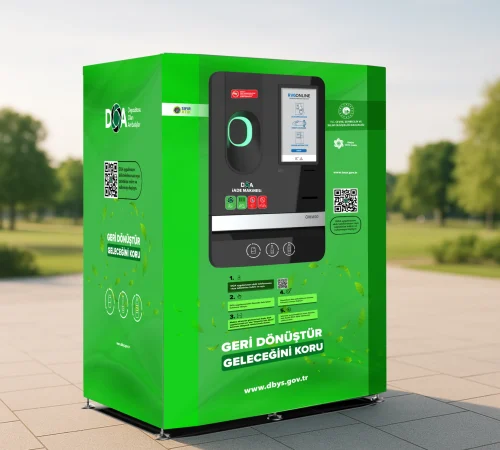
The biggest challenge lies in the volume and cost burden created by storing and transporting returned packaging. This is where Reverse Vending Machines (RVMs) play a critical role.
RVM systems equipped with integrated crushing and compaction technologies:
Reduce waste volume at the source by up to 80%
Minimize storage space requirements
Decrease transportation frequency
Keep operational costs under control
For businesses lacking this technology, the deposit return system can gradually turn into a serious logistical burden. However, with the right infrastructure in place, reverse logistics can be optimized, making costs manageable—or even advantageous.
Data Management: The New Power of Sustainability
Deposit return systems are not merely physical collection processes; they are also powerful data generation mechanisms.
Thanks to IoT-enabled smart RVM units, businesses can instantly answer key questions:
How many containers were collected at each branch?
What are the material types and purity rates of collected items?
How are daily, weekly, and monthly performance trends progressing?
Which locations demonstrate higher consumer participation?
This data is critical not only for operational improvement but also for ESG (Environmental, Social, and Governance) performance. Investors and financial institutions now demand concrete, verifiable, and reportable environmental data. Systems capable of real-time reporting directly impact your company’s sustainability score and investment attractiveness.
A Strategic Advantage for Retail: Customer Loyalty
Deposit return machines are not merely recycling solutions; they are also powerful customer engagement tools. When consumers return their empty packaging to a machine, they can instantly receive digital coupons, discounts, or loyalty points. This experience:
Increases in-store traffic
Boosts repeat visit rates
Builds emotional connections with the brand
Rewards environmentally conscious behavior
Businesses that are unprepared risk losing this return habit to competitors. This means losing not only recycling data but also valuable customer touchpoints.
Is It Possible to Turn the Deposit System into a Profit Center?
With proper planning and technological investment—yes.
A mandatory deposit return system brings multiple strategic advantages, including:
Logistics optimization
Data-driven decision-making
Improved ESG scores
Integration with customer loyalty programs
Strengthened brand value
The critical question is this: Is your company managing this system merely as an obligation, or transforming it into an operational and financial opportunity?
Preparing for the Future Starts Today
The circular economy is no longer a vision it is the new norm of the business world. Mandatory deposit return systems are among the most visible and rapidly expanding components of this transformation.
For prepared businesses, this process means:
Minimizing regulatory risks
Increasing operational efficiency
Strong ESG reporting
Enhanced customer loyalty
Competitive advantage
For those unprepared, however, the risks of rising costs, operational complexity, and market loss continue to grow.